
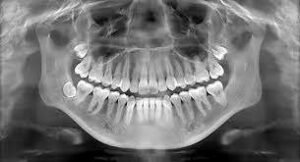
Dental X-rays are often the source of conversation when it comes to scheduling your next dental appointment. For some, it feels pointless or redundant… and for others they may worry about the exposure from radiation. Let’s dive into x-rays… and do we really need them?
Why do I need them?
X-rays are vital to diagnosing bone and gum disease, cavities, oral cancer, sinus issues, and more. This is why the states and governing boards have made it a mandatory requirement that a dental exam, x-rays, complete medical history and blood pressure be taken for every new patient. Your dentist also has a moral and ethical obligation to care for your health.
When it comes to x-rays, they are always required at your first visit. If you’ve had x-rays taken recently at another dentist, you can often have those x-rays sent to your new dentist. Depending on the quality of these x-rays as well as when they were taken, you may or may not be prescribed additional x-rays. The goal of x-rays is to complete a thorough examination.
X-rays are prescribed based on your age, risk factors, existing restorations, and/or history of cavities, crowns, root canals, and/or implants. Many dental and periodontal (gum and bone) conditions are not felt or detected by the patient until they become a bigger problem. Cavities between the teeth start out small and cannot be seen by the naked eye. At that stage, there is likely no sensitivity noticed by the patient. Over time, cavities will grow into visible dark holes in the teeth and eventually can spread to the nerve or the tooth can actually break apart from the cavity. Through this progression, the treatment needed to fix the problem often becomes larger, more invasive, and more expensive. This is why it is so important to catch dental and periodontal disease early on with the help of radiographs x-rays. X-rays can show these problems at an early stage: smaller more manageable cavities, early bone loss (gum disease), or even sometimes tumors.
If you’ve had either 1) recent cavities or 2) A history of crowns, root canals, and/or implants or 3) are a new patient of a practice, your dentist will likely recommend x-rays at your visit.
Are they Safe?
YES! Dental radiographs are safe and will only be recommended as needed. When you hear the word radiation, it can understandably make you nervous. This is because we have all been told about the link between radiation and cancer. The good news is there have been many technological advances in the world of medical and dental x-rays. We actually need to use very little radiation in order to get the images we need. In fact, the radiation used in dentistry is comparable to radiation received daily from the sun, airplane flights, buildings, etc. The main difference is we focus the radiation to the area requiring an image. Take a look at this chart below to give you a better understanding of the level of radiation you are receiving every day.
How often should I get them?
As a new patient to a dental office, it is important to get a complete series of radiographs in order for your dentist to get the full picture of your oral health. This includes a panoramic radiograph (shows the entire dentition as well as the upper and lower jaw bones), 4 bitewing radiographs (shows all back teeth, helps visualize decay as well as bone loss), and periapical images of the front teeth as well as any areas containing previous root canals, implants, or areas of concern (shows the teeth and root area, helps visualize decay, bone loss, and infection around the root).
After this first visit, it is often recommended to have follow up 4 bitewing and periapical images annually. This is however not a hard rule, as some patients are at a higher risk of pathology and may need radiographs taken every 6 months. It is also possible to be a low-risk patient and get radiographs taken every 2 years. Don’t be afraid to ask your dentist about what interval suits you best! We are here to help.
Can things really change in 6 months?
Things can change and/or become more apparent on a newer image due to changes in size and severity. Even the angle of the x-ray can reveal something that was not visible on a previous x-ray!
What if I still don’t want them?
As your healthcare provider, we are responsible for upholding a standard of care. Without x-rays, we can miss cavities, periodontal disease, bone loss, infection and oral cancer.
How often you get x-rays may vary based on your overall health and the existing dental work in your mouth. If you have had dental work in the past or dental work recently, it is likely your dentist will recommend x-rays more often than someone who has not.
There may be an inherent mistrust regarding why your dentist is recommending x-rays for you. Trust is paramount to your dental health care. The best case scenario would be to find a dentist whom you trust. When they have a recommendation, you can be certain it is being made from a professional, evidence-based and genuine standpoint.
What if my Medical doctor says I should not get them?
As healthcare providers we are always happy to speak with your physician and acquire the necessary documentation that states you should not have x-rays. Typically, this would be due to a history of head and neck cancer/radiation or recent extensive radiation for other medical purposes.